

When you consider places in your life, it comes down to a few categories. There are places you go because you live or work there. And then there are the other places like the café where you linger longer than planned, the park bench where you can sit without buying anything, the library where nobody bothers you, the market where you run into familiar faces, or the pedestrian street where the city suddenly feels more alive. Those places are often referred to as third places (sometimes called third spaces). They’re separate from home (first place) and work (second place), and they give people somewhere to exist in public without making a big deal about it.
A third place can be somewhere social, quiet, casual, creative, familiar, or place where you remain anonymous. You might talk to someone there but you could equally just sit alone. You might read, people-watch, work on a laptop, meet a friend, eat a snack, listen to music, or just feel like you’re part of the city for a little while. That sounds simple enough, but these spaces matter more than people realize. The concept of third places is becoming increasingly popular as they’re rapidly disappearing in far too many cities, and people are noticing.
Third Places Are Getting Harder to Find
The idea of a third place can sound almost romantic. Whether it’s a friendly café, local bar where everyone knows your name, park full of neighbours, or a bookstore where you can browse without being rushed, they give you somewhere to go. In real life, third places aren’t always so easy to come by. Many public and semi-public spaces now come with a cost. Cafés expect you to buy something. Restaurants and bars are getting increasingly expensive. Shopping malls are disappearing and many have become run down and unappealing as a place to go, or simply not welcoming, with few seating areas. Even sitting somewhere for a long time can feel awkward if you’re not spending money.
At the same time, a lot of people are dealing with higher rents, tighter budgets, remote work, loneliness, and social lives that require more planning than they used to. It’s one thing to say, “Go meet people.” It’s another thing to have affordable, welcoming places where that can happen naturally. That’s why third places are worth talking about. They help people feel grounded, connected, and less boxed into the cycle of home, work, errands, and screens.
Third Places Don’t Always Happen by Accident
Third places can take time to find. The idea sounds simple enough but in reality, few spaces are available to locals. You’d think it would be easy. You go somewhere outside of your home and workplace (or school), become a regular, and feel more connected to your neighbourhood. In real life, it doesn’t always work that smoothly. Some places are simply too much (such as being too expensive, loud, commercial, cliquey, or awkward for casual socializing). Other places are technically public but don’t really invite people to stay. That’s why a good third place is partly about the location and partly about repetition. You usually need to return to the same place often enough that it starts to feel familiar. That could be a park, café, library, gym, market, class, club, or community event. The place matters, but so does the habit of showing up.
Urban Planning Failure
I tend to see third places as spaces where natural social interaction happens. Take a city like Barcelona in Spain, for example. There are interior block courtyards where anyone can show up with a guitar and soon after, others will sit around and mingle. This type of of urban planning is missing from design in Canada and the US. On the other hand, some people just want to spend time outside of their home, even if it’s to be alone but in a different setting from their usual routine. Both of these are require proper urban planning and since we lack this key feature in our cities as unquestionably important, third places are further drying up.
Why Montreal Feels Different in the Summer
Montreal changes in the summer. After a long winter, the city quickly opens up. The sidewalks get busier, people rush to the parks, and terrasses appear on every inch of extra space outside of eateries. Not to mention that many streets close to cars, festivals take over public spaces, and people who barely saw their neighbours in February suddenly see half the city outside.
Third places exist all year, but in Montreal, summer makes them easier to notice and enjoy without much planning. Some are official, such as libraries, public markets, community centres, parks, plazas, and pedestrian streets. While others are informal and these are the ones that I believe really bring people together as worthwhile third place. It could be a stoop or low lying porch, picnic blanket in the park, favourite bench, corner café, or even a street festival that you wander into without a plan. Montreal is especially good at this because so much of the city’s summer culture happens outdoors. You don’t always need a ticket or a reservation. Sometimes you just need comfortable shoes, decent weather, and somewhere to sit.
Parks Are the Classic Montreal Third Place
Montreal parks may be the city’s most obvious third places. Noteworthy green spaces like Mount Royal, La Fontaine Park, Jarry Park, Jeanne-Mance Park, Laurier Park, Angrignon Park, and dozens of smaller neighbourhood parks give people room to gather without needing to spend much. You’ll see people reading, playing music, having picnics, walking dogs, doing yoga, playing chess, throwing frisbees, or sitting alone with a coffee. That mix is part of the appeal. A good park doesn’t force one kind of behaviour. You can be social or private. Active or lazy. With friends or by yourself. You can stay for ten minutes or two hours. In a city where apartments can be small and rents can be high, parks become shared living rooms. They give people space they may not have at home.
The Tam-tams
The famous Tam-Tams on Mount Royal may be one of Montreal’s clearest examples of a third place. On Sundays during the warmer months, people gather near the Sir George-Étienne Cartier monument to drum, dance, picnic, watch performers, meet friends, or simply sit in the grass and take in the scene. It’s informal, recurring, public, and free, which is exactly what makes it feel different from a paid event or a planned night out. You don’t need to be a drummer to belong there. You can show up for the music, the people-watching, the park, the sunshine, or the feeling that the city has gathered in one place for the afternoon.
What about libraries?
Even though relatively few people use them these days, libraries are underrated third places. They’re free, quiet, useful, and open to almost everyone. You can read, work, study, cool off, use Wi-Fi, browse books, attend events, or simply sit somewhere peaceful. For people who work from home, live with roommates, need a break, or want a place where they don’t have to buy a drink every hour, libraries can be incredibly valuable. I’ve used libraries as a place to work, just to get a fresh surrounding while working.
They also serve different generations at once. Students, seniors, parents with kids, freelancers, newcomers, and people who just need a calm place can all use the same space without needing the same reason. That’s actually rare but it’s a common element to libraries as a third place.
Cafés, Terrasses, and the Cost Problem
Cafés and terrasses can be great third places, but they come with a catch. That is, they usually cost money. A neighbourhood café can feel warm and familiar and you might recognize the staff, run into people you know, or have a favourite table. A terrasse can make an ordinary evening feel like a small event. While places like these help create the social texture of Montreal, they’re not equally accessible to everyone. A $8 coffee or a $17 drink isn’t nothing, especially when people are already watching their grocery bills, rent, and transportation costs. So while cafés and terrasses can function as third places, they’re also limited by the fact that spending is usually expected. So I’d accept them as a viable option but with a caveat that you’ll have spend each time, which takes away from the core idea of a useful third place, in my opinion.
Markets, Pedestrian Streets, and Summer Wandering
Public markets and pedestrian streets are another big part of Montreal’s summer third-space culture. Places like Jean-Talon Market and Atwater Market are about shopping, of course, but they’re also about wandering. You can grab something small, look around, meet a friend, or take in the energy of the crowd. You don’t have to spend money to be there.
Pedestrian streets add something similar. When cars are removed, people behave differently. They slow down and look around. They come across food, music, conversation, people dancing, or even nothing in particular. A street becomes more than a way to get somewhere that it becomes a destination in and of itself because it becomes somewhere to be. Think about it. Not everything has to be a clear destination and pedestrian streets give people the opportunity to wander and discover.
When Saint Catherine street is closed to vehicle traffic for the summer, The Village becomes an enjoyable third place. There are plenty of seats and great people watching. It’s a lively part of downtown and is worth the trip to the area, which includes the park at Berri-UQAM metro, Place Émilie-Gamelin. There are many activities that place there during the warmer months.
The Old Port Is a Classic Wandering Space
The Old Port also works as a Montreal third place, especially in the warmer months. It’s not always quiet, and parts of it can feel touristy or commercial, but it gives people a big public area where they can walk, sit by the water, meet friends, watch performers, grab something small to eat, or simply be around the energy of the city. For some people, the appeal is the river. For others, it’s the boardwalk, views, street life, public events, or the feeling of being somewhere active without needing a complicated plan. Like many third places, the Old Port works best when you use it your own way, be it a casual walk, a low-key meetup, a place to bring visitors, or a summer evening route when you want to get out of the house.
Festivals Make the City Feel Shared
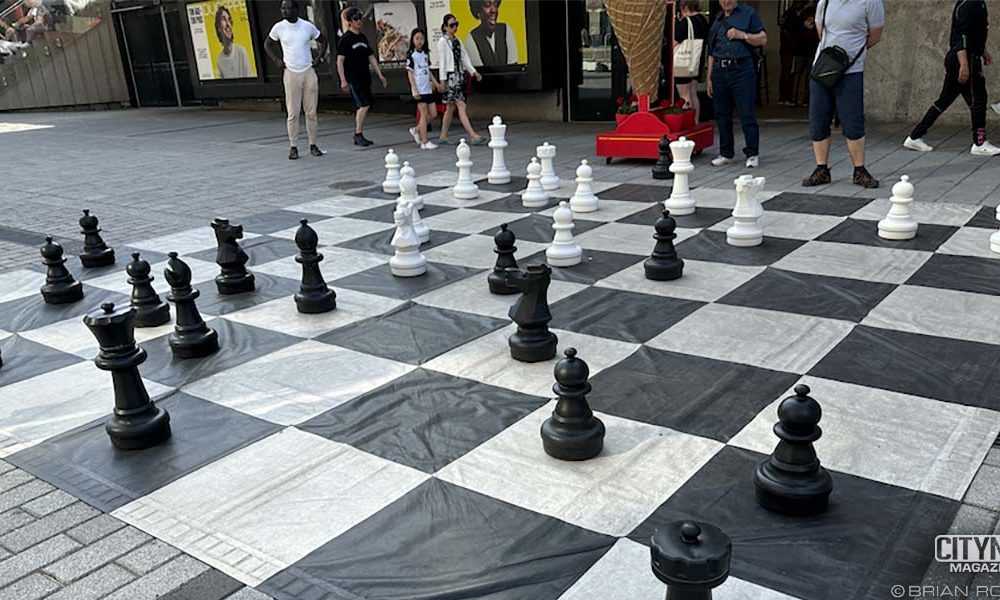
Montreal’s festival season turns parts of the city into temporary third places. Outdoor music, comedy, food events, cultural festivals, street performances, and public installations all create places where people can gather casually. Even when you don’t attend the main event, you can often feel the energy nearby. Even just walking down Saint Catherine street, such as around Place des Arts for example, you can engage in a game of giant chess. If you’re alone or have time to spare, you can meet a stranger and play with them, for free.
This is one of Montreal’s strengths. The city knows how to create a sense of public life. You can walk through a festival area and feel like something is happening, even if your plan was just to meet a friend or wander downtown.Of course, festivals can also be crowded, commercial, and expensive depending on the event. But at their best, they give people a shared summer experience that doesn’t require much explanation. You check it out and feel part of something.
Community and Recreation Centres Can Be Hidden Gems
Community and recreation centres are another type of third place, though they can be a little harder to figure out than parks, cafés, or libraries. A recreation centre usually focuses more on sports, fitness, classes, and leisure activities, while a community centre often has a broader social role. In practice, these two overlap because many neighbourhood centres offer both recreation programs and community services. Some are very active, while others are more focused on scheduled programs, kids’ activities, seniors’ groups, workshops, local services, or room rentals. That means they may not always feel like places where you can casually walk in and hang out. Still, it’s worth checking what’s nearby because you may find a local gem. You might discover that it’s a place to take an art class, join a walking group, play badminton, attend a workshop, volunteer, meet neighbours, bring kids to an activity, or take part in a low-cost community event.
In Montreal, examples include places like the Centre des loisirs de Saint-Laurent, Tyndale St-Georges Community Centre in Little Burgundy, the Cummings Centre for adults 50+, local community centres in NDG, and recreation programs listed through Loisirs Montréal. Some of these places are more useful for organized activities than spontaneous hanging out, but that still counts. A third place doesn’t have to be a cool café or a packed summer park. Sometimes it’s the neighbourhood room where people take a class, chat after an activity, and slowly start recognizing each other. A friend of mine realized that dating apps aren’t for him anymore and ended up dating someone from one of his third place community centre activity groups.
Some Third Places Are Built Around Activities
Third places aren’t always places where people simply sit around and talk. Some of the best ones are built around a shared activity. That could mean a climbing gym, dog park, skatepark, dance class, pottery class, book club, card shop, quiz night, curling club, open mic, orchestra practice, roller skating group, run club, cycling route, tennis court, sports league, or local hobby group. These spaces can be easier for people who find casual socializing awkward because the activity gives everyone a reason to be there. You don’t have to walk up to strangers and invent a conversation from nothing. You can talk about something external that unites you and those around you like the game, class, route, dog, book, music, workout, or event. In Montreal, this matters because a third place doesn’t have to be a perfect neighbourhood café where everyone magically becomes friends. Sometimes it’s the place you return to every Tuesday night, where people slowly start to recognize you because you keep showing up.
Green Alleys and Neighbourhood Life
Montreal’s green alleys, or ruelles vertes, are smaller and quieter than parks, but they can still work as informal neighbourhood third places. In some areas of the Plateau, Rosemont, Villeray, Verdun, and Petite-Patrie, back alleys have been turned into greener shared spaces with planters, murals, benches, small gardens, little free libraries, and places where kids can play. They’re usually more local than destination-based, so you probably wouldn’t cross the city to visit one. But if there’s one near your home, it can become the kind of place where neighbours stop to chat, parents recognize each other, kids play after school, and the block starts to feel a little more connected.
Why Third Places Matter Right Now
Third places matter because people need places where they can feel part of the world without constantly performing, consuming, or scheduling. Remote work has made this more obvious because when home and work blend together, people need somewhere else to go. It doesn’t necessarily have to be somewhere productive per se, but you do want something a little different. With little to no economic help coming from those running things, it’s up to us to find a third place that works for each of us to help make it through life.
Loneliness is part of this too. A third place doesn’t magically solve social isolation, but it creates the conditions where casual contact can happen. You see familiar faces. You overhear life around you. You feel less sealed off from everyone else. And in a time when going out can get expensive fast, low-cost, and free third places become even more important. A city shouldn’t only feel alive to people who can afford restaurants, concerts, and paid activities every week.
Third Places Take More Effort in Winter
Summer makes Montreal’s third places easier to notice because people spill into parks, markets, terrasses, festivals, pedestrian streets, and public plazas. Winter changes the equation. The need for third places doesn’t disappear, but the options often become more indoor, scheduled, and sometimes more expensive. That’s when libraries, bookstores, museums, community and recreation centres, climbing gyms, dance classes, curling clubs, cafés, malls, arenas, swimming pools, and hobby groups become more important. In winter, the best third place may be less about finding a beautiful place to wander and more about finding a recurring activity that gives you a reason to leave the house and see familiar faces.
How to Find Your Own Third Places in Montreal
The best third places are often the ones you return to. Instead of only asking, “Where can I go?” it may help to ask, “Where could I show up regularly?” That changes the search. A good third place might be a park near your apartment, a library branch, a café that doesn’t rush you, a market you like walking through, a pedestrian street that feels good in the evening, a community centre, a dog park, a class, a club, a volunteer shift, or a weekly activity.
You don’t need to turn it into a big project. Just pay attention to the places where you feel comfortable lingering, where you can spend time without too much pressure, and where you might slowly start to recognize familiar faces. Sometimes the right third place is social right away. Other times, it becomes social only after you’ve been there a few times.
Montreal has a lot of those places in the summer. They’re not always perfect. They’re not always free. They’re not always available to everyone in the same way. But when you find one that works for you, it can make the city feel bigger, warmer, and more livable. And after a long winter, that’s part of what makes summer in Montreal feel so good.





RSS